
Rachel Hicks writes poems with a haunting beauty.
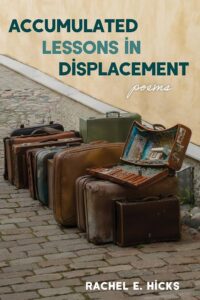
Poet and writer Rachel Hicks has lived in some unusual places. She was born in the foothills of the Himalaya Mountains, and she’s lived in India, Pakistan, Jordan, the Republic of Congo, Hong Kong, China, and the United States. Her nomadic background comes into full play with her debut poetry collection, Accumulated Lessons in Displacement.
When I started reading, I expected to see those international experiences reflected in the poems. And they’re there. What I did not expect was the find so many poems of a haunting beauty, that leaves you with a sense of awe. But that’s what I found.
Here’s one example from the collection.
Melancholy
 Always a longing—marrow deep—for home,
even when knowing by heart I’ve never
been there before. It must be the Irish
in me: the throat’s lump of yearning that swells
on the third day in a row of lead skies,
the comfort of a lonely wind, its wail
when all else is silence. There’s something in
the thin places, the gauzy veil between
here and there, visible, invisible.
I feel this as I get older. Longing
grows—for the hidden life, the glade, the glen,
the hand of silence cupping me; for mist,
a thicker green, a cottage, gray stones, rest,
moss and ferns, water from a cloistered spring.
Always looking back to Eden, forward
to the City with the trees—the ones with
golden leaves for our healing. Early on,
we’ll go sit on that bank from time to time,
when the melancholy pricks. And the leaves—
the golden leaves—will heal, refresh, reknit,
console. Perhaps a time will come when we
no longer need them. We can leave them, then,
for others, newly arrived.
I’ve experienced that “comfort of a lonely wind, its wail / when all else in silence.” I’ve felt in on a high ridge overlooking Durango, Colorado; biking a converted railroad trail along the Missouri River; standing outside a cathedral in Erfurt, Germany; and even on a late afternoon walk in my small St. Louis suburb. That wind contains a wail, a lonely wail that comforts in its memory of home.
How did Hicks capture that? She’s describing a longing for home, the home she, and we, may have never even visited but we know is there.
All these poems are like that. Hicks is wrestling with something – call it faith, call it life – something that is larger than each of us and all of us. And she does it seemingly effortlessly, in some of the most beautiful and memorable contemporary poems I’ve read.
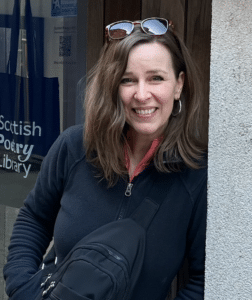
Rachel Hicks
Her travels and the countries where she lived also provide fertile ground. Hicks considers the mountains of northern India, and what happens when she walks through the door of a Punjab shop in Baltimore. She watches the solitary figure of a woman running slowly up a hillside, trying to outrun the Japanese tsunami of 2011. She meets the hospitality of a farmer’s wife in China (and also a plague of cicadas).. And she encounters high winds on the Chesapeake Bay Bridge.
And the title poem, “Accumulated Lessons in Displacement,” reads like a description of a refugee’s life. Told in eight short parts or lessons covering two pages, it punches right in the gut, whether it’s the boy collecting bullet casing to make his sister a necklace or the inevitable grief that accompanies abandoning everything you’ve known.
Hicks is a poet, essayist, and fiction writer. Her work has been published in such literary and online journals as Ekstasis, Front Porch Republic, St. Katherine Review, Baltimore Review, Relief, Veritas Journal, and many others. A three-time Pushcart Prize nominee, her short story “Drink It Dry” won The Briar Cliff Review’s annual short story contest. She also serves as the assistant editor of Mars Hill Audio. She lives in the Baltimore, Maryland area.
Accumulated Lessons in Displacement is more than a collection of beautifully written poems. It’s a song of the heart, a song of wonder, and the use of words and language at its best.
Photo by Khanh Hmoong, Creative Commons, via Flickr. Post by Glynn Young.

How to Read a Poem uses images like the mouse, the hive, the switch (from the Billy Collins poem)—to guide readers into new ways of understanding poems. Anthology included.
“I require all our incoming poetry students—in the MFA I direct—to buy and read this book.”
—Jeanetta Calhoun Mish

- Poets and Poems: Rachel Hicks and “Accumulated Lessons in Displacement” - November 3, 2026
- Poets and Poems: Penelope Moffett and “Think of It as Music” - October 29, 2026
- “The Book of Joy: 100 Poems for Your Heart” by L.L. Barkat - October 27, 2026
Leave a Reply